Monday, December 11, 2006

Sunday, December 10, 2006

Saturday, December 09, 2006
Friday, December 08, 2006
Friday Update
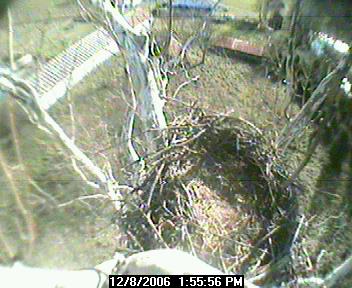
Here's an update on the cams. Good news and less than good news.
First the good--the transition work is complete and the still cam is online.
now the less than good--the video feed was on yesterday. That was only a test. As I mentioned earlier, the video feed will start full time after the first of the year. Sorry. I got pretty excited too when the cam was up yesterday.
thanks for your continued comments of support. We really appreciate it.
Friday 8 December
A little snow last night.
On the live link, click here. This will give you the realplayer link. Once it's downloaded on your desktop, doubleclick on it and that will open the live feed link. If any of this info changes I'll get it out to you folks ASAP.
As I write this at 8:48 am, the feed is down.
On the live link, click here. This will give you the realplayer link. Once it's downloaded on your desktop, doubleclick on it and that will open the live feed link. If any of this info changes I'll get it out to you folks ASAP.
As I write this at 8:48 am, the feed is down.
Thursday, December 07, 2006
Afternoon pic

Update--
The locked up still cam shot is being dealt with in Denver!
Also, the live feed is up. Access the realplayer file through the link here on this blog. The link will be put up on the eaglecam webpage soon.
Thursday December 7
New thread.
Hang in there. The cam will come back on. They are working on the transfer to Wheeling.
Hang in there. The cam will come back on. They are working on the transfer to Wheeling.
Wednesday, December 06, 2006
We're Up and Running
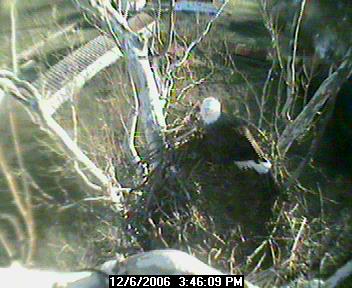
update: We still have some cleanup work to do on webpage text, and on our connections. The site is currently running through Denver. We will make the transition to Wheeling tomorrow.
None of us can believe that an eagle was in the nest when we finally went live.
Tuesday, December 05, 2006
Up and running, almost
By now you've probably seen the new web page for the cam. Note-- to actually get to the cam it's one more click as we are hosting the cam offiste to preserve our bandwidth.
Picture still is not quite right, but the guys are working on it.
Thanks to our contracting and technical folks for making this happen so quick (by our standards here at least).
more soon.
Picture still is not quite right, but the guys are working on it.
Thanks to our contracting and technical folks for making this happen so quick (by our standards here at least).
more soon.
Monday, December 04, 2006
Sunday, December 03, 2006
Friday, December 01, 2006
Friday
New thread.
Saw an adult bald eagle flying low over the Shenandoah River near Berryville, VA this am.
Saw an adult bald eagle flying low over the Shenandoah River near Berryville, VA this am.
Thursday, November 30, 2006
Wednesday, November 29, 2006
Molting
Here's some info from Bent's on Bald Eagle plumage and molting:
Plumages.--When first hatched the downy young eaglet is completely covered with long, thick, silky down, longest on the head; it is "smoke gray" on the back, paler gray on the head and under parts, and nearly white on the throat. When the young bird is about three weeks old this light gray or whitish down is pushed out and replaced by short, woolly, thick down of a dark, sooty-gray color, "hair brown" to "drab." The plumage begins to appear on the body and wings, scattered brownish-black feathers showing on the scapulars, back, and sides of the breast, when about five or six weeks old; at this age the wing quills are breaking their sheaths. At the age of seven or eight weeks the eaglet is fairly well feathered, with only a little down showing between the feather tracks, and the flight feathers are fully half grown.
In fresh juvenal plumage the young eagle is uniformly dark colored "bone brown" to "clove brown" above and below; the flight feathers are nearly black, but there is usually a slight sprinkling of grayish white in the tail. This plumage is worn throughout the first year without much change, except by wear and fading, the under parts fading to "hair brown."
After the first annual molt, the next summer, the plumage becomes paler and much mixed with white in very variable amounts. Individual feathers on the back, scapulars, and breast are more or less extensively white, those of the breast and belly being largely white in some specimens. I am not sure whether this is a second or third year plumage, or both; if the latter, the third year is whiter than the second. The tail is more extensively mottled with white than in the first year, and the feathers of the crown and occiput are broadly tipped with pale buff. After the next annual molt the plumage of the body becomes darker, much like that of the adult, but lightly tipped with white below and mottled with white on the rump and upper tail coverts; the latter and the tail are now quite extensively white; the head is mixed with white above, about half white and half brown, or nearly clear, dirty white below. This is probably the third year plumage. At the next annual molt, early in the fourth year, the bird assumes a plumage that is practically adult, with a pure-white head and tail; but usually remaining signs of immaturity are seen, such as a few brown feathers in the head and some dusky mottling near the tip of the tail.
The length of time required to assume the fully adult plumage does not seem to have been positively determined, and it may take longer than I have estimated. Adults and immature birds have one complete annual molt, which is very gradual, and prolonged through spring, summer, and fall. The flight feathers are molted mainly during July, August, and September.
Plumages.--When first hatched the downy young eaglet is completely covered with long, thick, silky down, longest on the head; it is "smoke gray" on the back, paler gray on the head and under parts, and nearly white on the throat. When the young bird is about three weeks old this light gray or whitish down is pushed out and replaced by short, woolly, thick down of a dark, sooty-gray color, "hair brown" to "drab." The plumage begins to appear on the body and wings, scattered brownish-black feathers showing on the scapulars, back, and sides of the breast, when about five or six weeks old; at this age the wing quills are breaking their sheaths. At the age of seven or eight weeks the eaglet is fairly well feathered, with only a little down showing between the feather tracks, and the flight feathers are fully half grown.
In fresh juvenal plumage the young eagle is uniformly dark colored "bone brown" to "clove brown" above and below; the flight feathers are nearly black, but there is usually a slight sprinkling of grayish white in the tail. This plumage is worn throughout the first year without much change, except by wear and fading, the under parts fading to "hair brown."
After the first annual molt, the next summer, the plumage becomes paler and much mixed with white in very variable amounts. Individual feathers on the back, scapulars, and breast are more or less extensively white, those of the breast and belly being largely white in some specimens. I am not sure whether this is a second or third year plumage, or both; if the latter, the third year is whiter than the second. The tail is more extensively mottled with white than in the first year, and the feathers of the crown and occiput are broadly tipped with pale buff. After the next annual molt the plumage of the body becomes darker, much like that of the adult, but lightly tipped with white below and mottled with white on the rump and upper tail coverts; the latter and the tail are now quite extensively white; the head is mixed with white above, about half white and half brown, or nearly clear, dirty white below. This is probably the third year plumage. At the next annual molt, early in the fourth year, the bird assumes a plumage that is practically adult, with a pure-white head and tail; but usually remaining signs of immaturity are seen, such as a few brown feathers in the head and some dusky mottling near the tip of the tail.
The length of time required to assume the fully adult plumage does not seem to have been positively determined, and it may take longer than I have estimated. Adults and immature birds have one complete annual molt, which is very gradual, and prolonged through spring, summer, and fall. The flight feathers are molted mainly during July, August, and September.
Tuesday, November 28, 2006
Monday, November 27, 2006
Sunday, November 26, 2006
Subscribe to:
Posts (Atom)
6/26 RJ fledged
607 today RJ fledged we are all excited that she finally left the nest 11 days after her sibling did which was the 15th way to go RJ she was...
